The FM screening
The moiré effect in T‑shirt and textile printing
 Inks and solutions
 Printing machines
 Printing Software
 Training center
MOIRE’ IN PRINTING
Moiré in T-shirt printing and textile printing
After many attempts, expert screen printers have achieved excellence in screen exposure, succeeding in getting a flawless and moiré-free halftone, by tilting the mesh of the screen upon screen stretching and optimising the use of the photoemulsion for screen printing.
Unfortunately, those screens allow good results when printing halftones on a flat surface like paper of plastic film but they again show a pronounced moiré effect if printed on fabrics such as the jersey of a t-shirt.
This moiré pattern, which appears in textile printing, is also known as third-order moiré and is caused by the interference of three overlapping regular patterns:
- The structure of the traditional AM halftone
- The structure of the screen-printing fabric
- The fabric, which also features a repetitive and regular pattern (such as the jersey fabric of a T-shirt)
Example of a jersey fabric
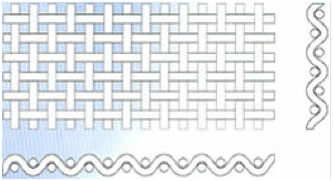

Someone has attempted to solve the moiré problem described above by using a screen pattern available in Photoshop (rather than in a professional RIP) called an “error-dispersion screen”. However, this type of processing not only removes most of the original shade halftone steps but also introduces such a high level of graininess and imperfections in the screen-printed output that the final print quality is often worse than the defects originally caused by the AM halftone used in screen printing.
STOCHASTIC SCREENING
The FM screening or stochastic screening was the major innovation in RIP software resulting from the development of the computer in prepress about 20 years ago. It was thought that it would revolutionize screen-printing technology across all graphic arts, including screen printing. However, this has not been the case; to date, only 5% of projects use stochastic screening because stochastic screens are quite complex to generate, and first-generation stochastic screens have proven difficult to manage and unstable in printing, leading to a decline in the use of this technical solution.
It is important to clarify that the stochastic screen is not an error-diffusion screen like the one found in Adobe Photoshop.
Unfortunately, although the dispersion screen in Photoshop is recommended in some blogs as a way to reduce moiré, it not only removes most of the original halftone details but also introduces such a high level of graininess and imperfections in screen-printed output that it results in poor and inconsistent print quality—with problems that are even worse than the imperfections originally caused by the AM screen used in screen printing.
Recent advances in computer graphics and the latest-generation algorithms for stochastic screening—which are far more complex than those used in error-diffusion screening—ensure excellent continuity and smoothness of gradations, as well as exceptional stability and print quality.
Given the complexity of stochastic screening today, there are very few RIPs that fully and professionally implement the latest generation of stochastic screening, and those that do are significantly more expensive.
Here are the reasons behind the development of XerioRIP XerioRIP.